











Autumn 1
Year 3- Multifaith Creation
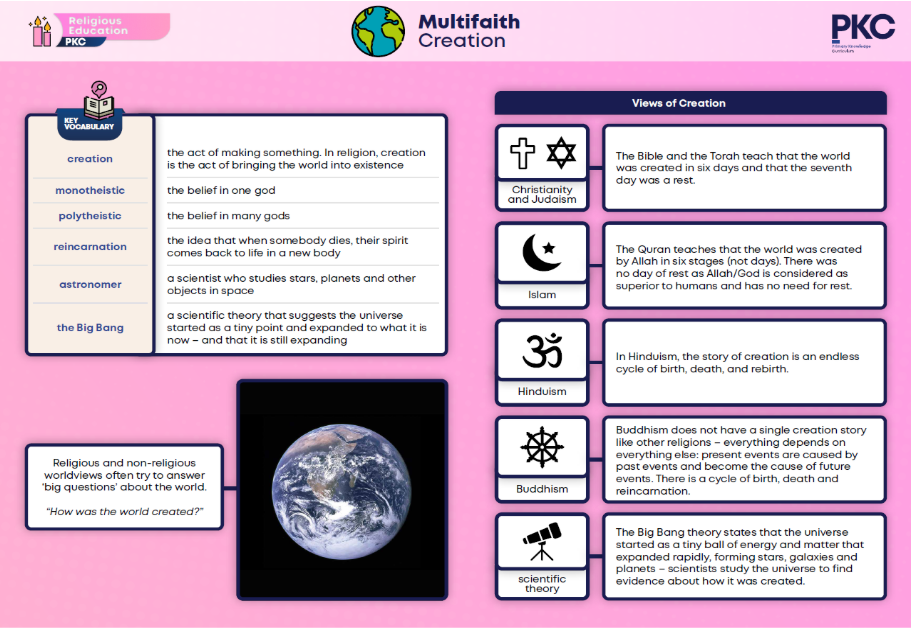
Key end points for this multifaith unit, Creation Stories, are:
- To know there are different views of creation.
- To know some religious views of creation, have a creator/creators, and some do not.
- To know there are alternative and non-religious views of creation such as the Big Bang Theory.
- There are some similarities and differences between views of creation.
This multifaith unit helps children understand that there are different perspectives on creation. They will explore:
- Religious views that include a creator
- Religious views that do not include a creator
- Non-religious world views on how the universe began.
Year 4- Multifaith Culture and Religion
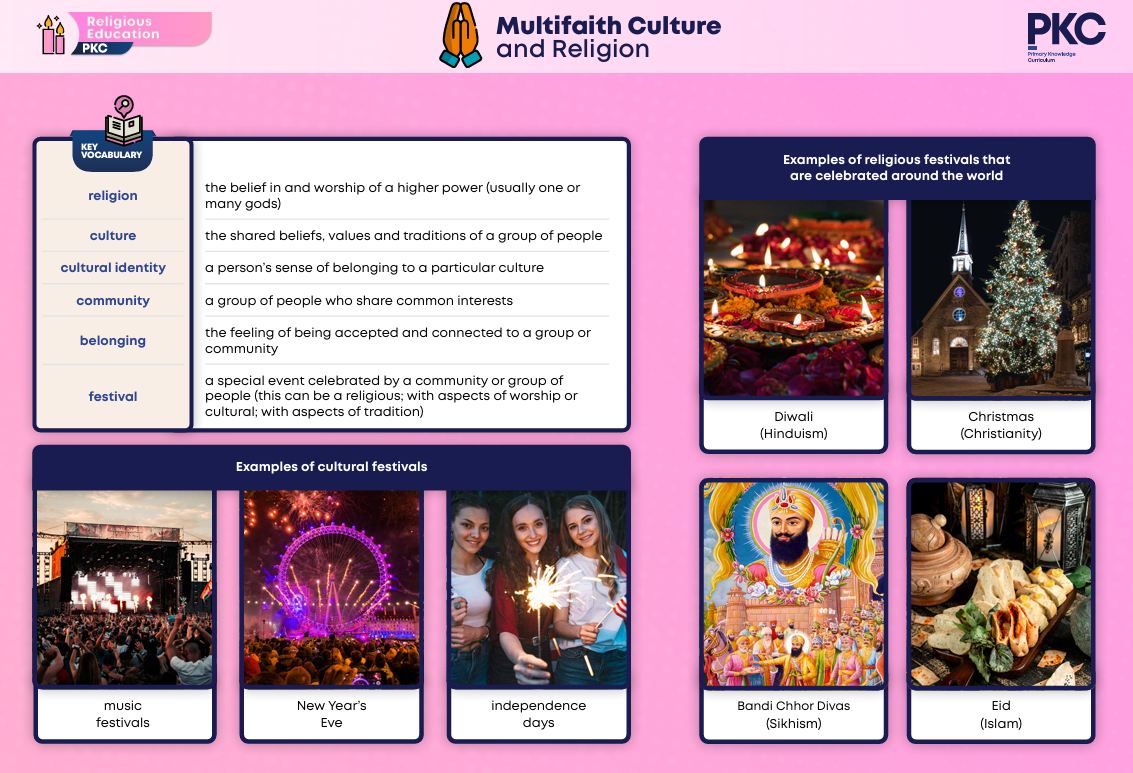
Key end points for this multifaith unit, Culture and Religion, are:
- To know that culture can be defined as a pattern of behaviour shared by a group of people.
- To know that some shared festivals can be influenced or directed by religion, e.g. Diwali
- To know that festivals can be a part of shared culture. To know that community is an important part of shared culture.
- To know that many shared experiences can be enjoyed by people of different religions.
This unit will begin by exploring culture as a combination 5 five different elements. These will be called the ‘five F’s’ for this unit. This includes fashion, flags, food, festivals and famous faces. These are not the only things that shape culture; they make up the majority of culture for many people and, therefore, will be the basis of explaining what creates an individual’s cultural identity for this unit. The use of imagery and different representations to highlight the learning should be used throughout.
Year 5 & 6- Multifaith Culture and Religion
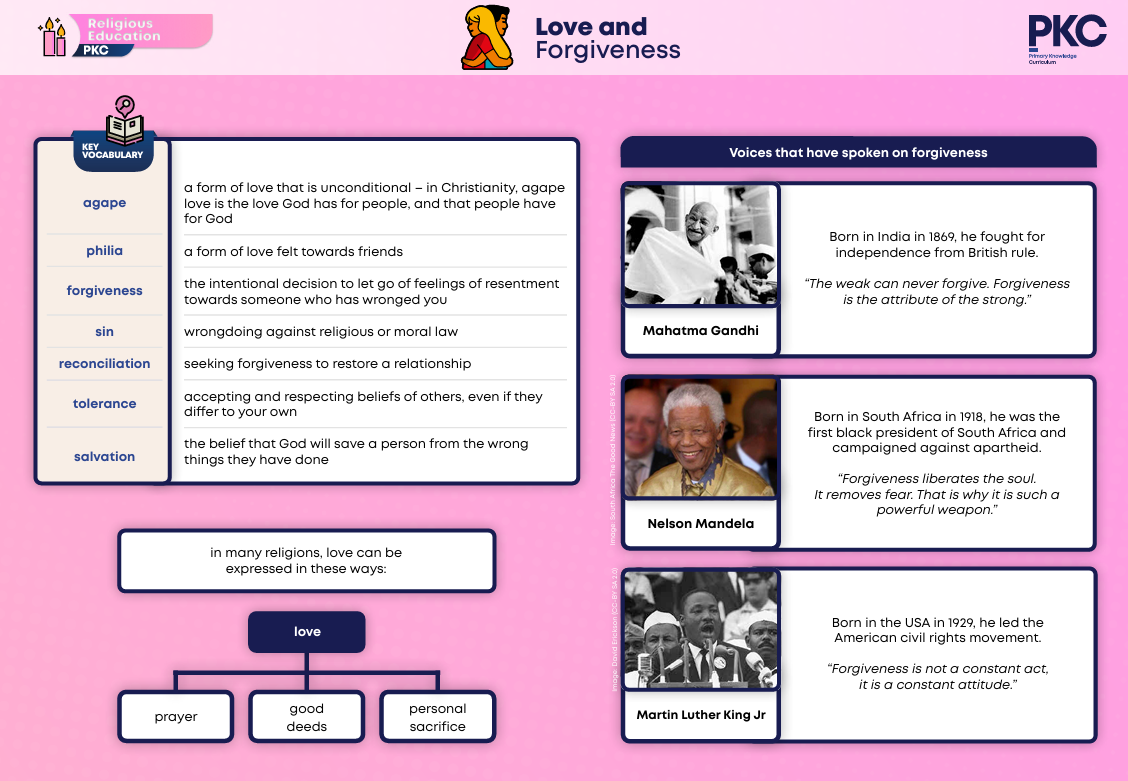
Key end points for this multifaith unit, Love and Forgiveness, Reconciliation and Redemption:
- To know that love is an important concept in religion.
- To know that forgiveness is an important concept in religion.
- To understand reconciliation is about making peace after a disagreement.
- To understand that redemption is an act of saving or being saved from a mistake.
This unit will also link to the later year 6 history unit, World War II. In this unit, children will revisit the parable of the good Samaritan and the prodigal/lost son to highlight the Christian perspective on love and forgiveness. Children should be able to see that many religions share a similar view on love and forgiveness. The intent behind this RE curriculum will be present in the year 6 units. We aim for children to be supported with the knowledge to derive opinions from world scenarios, to have confidence in sharing their own views while respecting others, and to comprehend challenging debates and arguments.